The Emotional Machine and the Empty Shell: A View of the Future from Jakarta
A stark contrast between the cutting-edge bionic empathy of UBTECH's U1 robot and the stagnant political, economic, and educational reality of Indonesia.
I recently came across an article and video detailing the global launch of the UBTECH UWORLD U1 robot in Shenzhen. It left me with a profound, unsettling sense of cognitive dissonance.
On one side of the ocean, humanity is actively bridging the gap between artificial intelligence and genuine human connection. The UWORLD U1 isn't just another cold, metallic arm designed for a factory floor; it is a hyper-bionic companion. With its lifelike silicone skin, 88 degrees of freedom, and a proprietary dual-pivot cervical spine, it can replicate up to 90% of fundamental human movements.
But what truly startled me was its "emotional AI" system. Powered by an emotion-driven large language model (LLM) running locally on a Rockchip RK3588 processor, the U1 can recognize more than 20 fine-grained emotional states with over 90% accuracy. It maintains eye contact, remembers past interactions via its "Agent Memory OS," and synchronizes its lip movements to its speech within 20 milliseconds. It is designed to understand our feelings, offer companionship, and respond to its environment with proactive empathy.
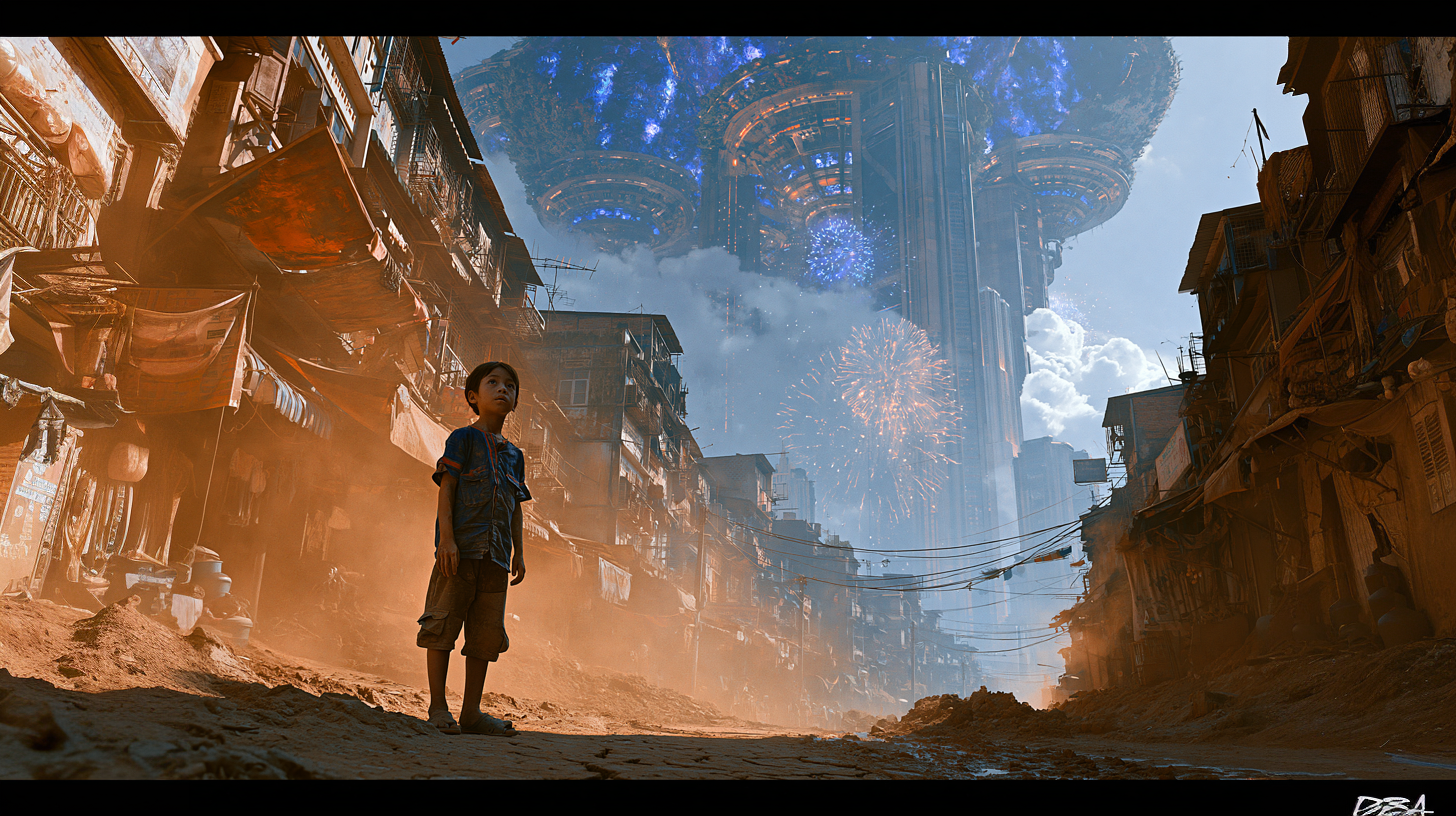
And then, I look out my window at Jakarta.
As I sit in the heart of Indonesia—the supposed epicenter of our nation's brightest minds and greatest potential—the contrast is devastating. We are living in a parallel timeline. While developed nations are literally engineering empathy into machines and skyrocketing into the future, Indonesia feels hopelessly stuck, drowning in endless, circular political theater.
The gap is no longer just technological; it is existential.
The Leadership Vacuum and the Illusion of Progress
It is deeply painful to watch the quality of the leaders tasked with steering our country. We have a cabinet where many ministers display a shocking lack of basic competence, public speaking ability, and intellectual depth. When confronted with public criticism, their responses are defensive, lacking in sound reasoning, and devoid of actionable solutions.
Instead, our leaders stand behind podiums and speak in empty, buzzing platitudes about "industrialization," "digital transformation," and "technological advancement." But these are just buzzwords echoing inside an empty shell. When you compare their grand speeches to the reality on the ground, the math simply doesn't add up.
How can we build a high-tech future when our foundational infrastructure is built on corruption and misaligned priorities? I look at massive, expensive programs—like building sprawling international airports in remote, rural areas where the local population consists primarily of low-income laborers who will never afford a plane ticket—and I wonder: Who approved this? Who is this actually for?
The inefficiency has reached a point where it defies economic logic. Today, it is significantly cheaper to import fruits or consumer electronics from abroad than to produce them domestically. Even after factoring in international logistics, shipping, customs, and taxes, imported goods still easily undercut local alternatives. We have failed to build a competitive, efficient supply chain, leaving us economically vulnerable and dependent.
The Education Crisis: Failing the Basics
Perhaps the most terrifying part of this trajectory is not our current leadership, but the intellectual state of our youth. The decline in cognitive and analytical capacity among young people is something I have witnessed firsthand, right in front of my own eyes.
I have watched high school students struggle to perform basic unit conversions—unable to calculate how many individual units are in a dozen. Even more shockingly, I have seen university students fail to solve simple percentages, unable to calculate even a basic calculation like $10% \times 1,000,000 = 100,000$.
When the young generation—the supposed "golden generation" of our future—struggles with basic primary-school arithmetic, how can we expect to produce the engineers, scientists, and thinkers who will build our own robotics or semiconductor industries?
Instead of addressing these core systemic failures in education and literacy, our political discourse in 2026 remains stubborn and distracted. We are constantly locked in polemics over high-cost, non-productive government programs. Initiatives like Makan Bergizi Gratis (MBG) and Koperasi Merah Putih (KMP) are marketed under the guise of bringing jobs to villagers and nourishing the poor. Yet, in practice, the execution is highly flawed. It feels as though these programs are structured in a way that allows the already wealthy and politically connected to extract massive profits, while the average citizen is left with crumbs.
The Sci-Fi Dystopia is Becoming Reality
When you watch a movie like Elysium or Alita: Battle Angel, the stark, brutal divide between the technological elite and the impoverished masses feels like hyperbole. We watch the ultra-rich living in pristine, climate-controlled environments with advanced medical bays, while the rest of humanity struggles in dusty, toxic scrap heaps below.
But looking at the current trajectory, those films feel less like science fiction and more like an impending forecast for countries like ours.
If we do not change—if our citizens continue to accept low-quality education and our government continues to prioritize political posturing over systemic development—we are heading straight toward that fractured future. We risk becoming a neglected, dusty region characterized by systemic poverty and environmental degradation, while developed nations use their advanced technology to manage their own closed-loop water supplies, synthetic oxygen, and automated food systems.
We are running out of time to bridge the gap. While China builds machines that can read human emotions, we are still struggling to teach our children how to count, and our leaders how to care.